Home
About Us
Our Team
Newsletters
Practice
Contact
Gallery

The Effect of Unauthorised Debit
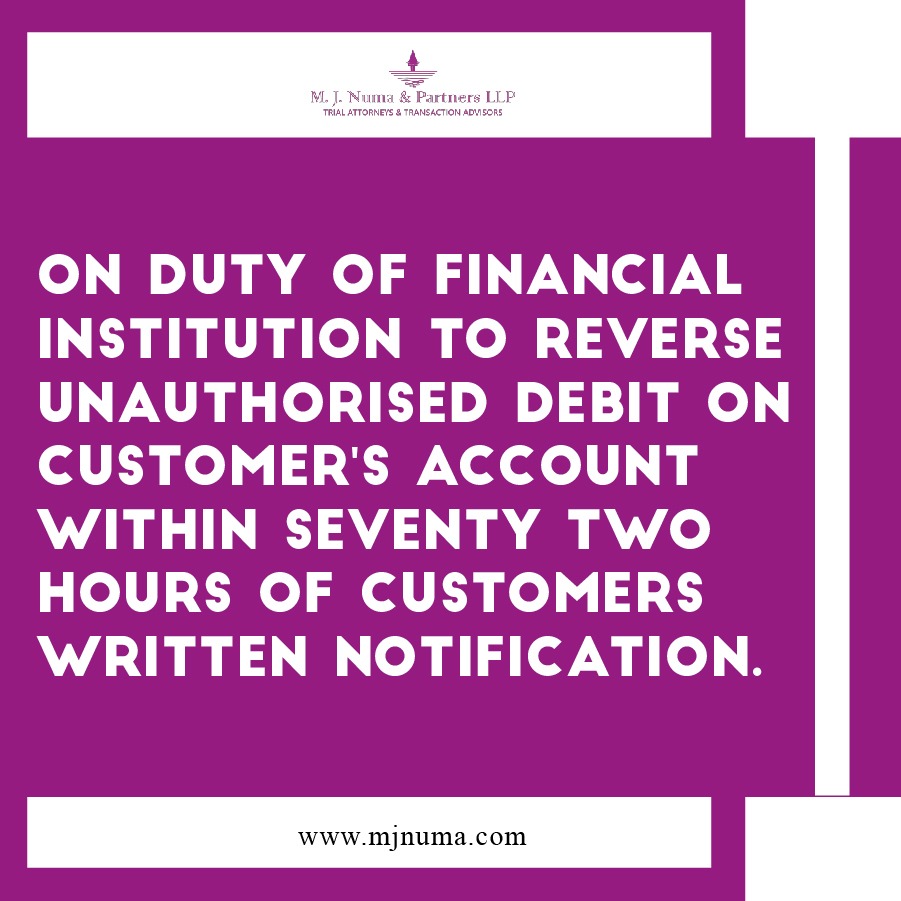
On duty of financial institution to reverse unauthorised debit on customer's account within seventy two hours of customers written notification.
Section 37(3) of the Cyber Crimes (Prohibition, Prevention, etc) Act 2015 states that a financial institution that makes an unauthorized debit on a customer's account shall, upon written notification by the customer, provide clear legal authorization for such debit to the customer or reverse such debit within 72 hours and that any financial institution that fails to reverse such debit within 72 hours, commits an offence and liable on confiction to restitution of the debt and a fine of #5,000,00. in this case, by the virtue of section of 37(3) of the Cyber Crimes (Prohibition, Prevention, etc) Act 2015, the appellant was bound to provide clear legal authorization for the unauthorized debits or reverse the unauthorized debits within 72 hours after it was
informed by the managing director of the respondent on 21st October 2016 or after it recieved the formal letter from the respondent on 24th october 2016 complaining about the unauthorized debits. The appellant did not provide any clear authorization of the debits within 72 hours of the receipt of the respondent's letter. Therefore, the appellant was bound to reverse the debits within the same 72 hours. (Pp. 516-517, paras. H-D).
Per Agim JCA (as he was) in United Bank for Africa Plc v. Vertex Agro Ltd (2020) Part 1754, Page 467 at 516-517
The existence of a right to die via euthanasia, also known as mercy killing and assisted suicide, is a question that crosses geographical boundaries and legal systems. Globally, prevalent jurisprudences prohibit and criminalizes assisted suicide and euthanasia. However, due to improvements in medical technology that have significantly increased our capacity to sustain and lengthen human life well beyond what was previously attained, along with a corresponding expansion of human rights law, many nations, including Belgium, the Netherlands, etc., have legalized euthanasia and assisted suicide. As a matter of fact, Switzerland was the first Country in the world to legalize assisted suicide in 1941. The right to life is unquestionably recognized on universally. The core issue in the ongoing discussion over euthanasia is whether or not there is a countervailing argument.
2023-12-05
On Thursday, the 18th of April, 2024, the House of Representatives Committee on Nigerian Content Development & Monitoring under the Chairmanship of Hon. Boma Goodhead as part of its inclusive approach to law-making processes organized a public hearing for deliberations on bills relating to the Non-Oil & Gas and Oil & Gas sectors in Nigeria.
2024-04-28