
Home
About Us
Our Team
Newsletters
Practice
Contact
Gallery

ARBITRATION CANNOT BE RENDERED IMPOTENT: THE SUPREME COURT STRENGTHENS NIGERIA'S ARBITRATION GOVERNANCE FRAMEWORK IN EMTS LIMITED V. AFDIN VENTURES LI
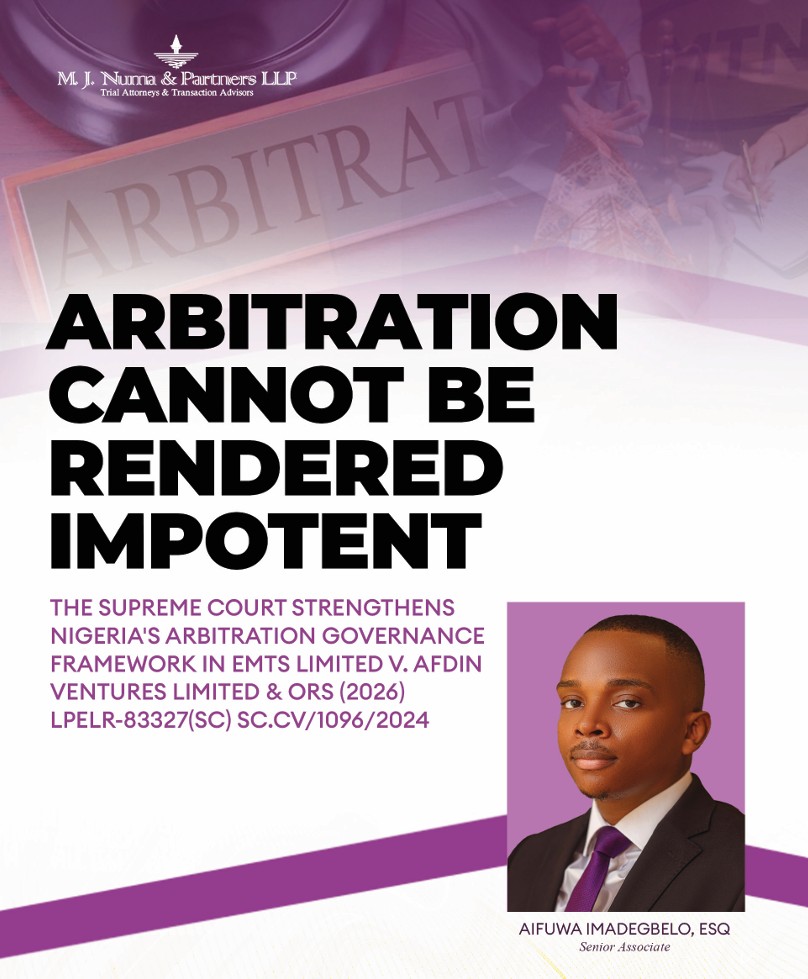
ARBITRATION CANNOT BE RENDERED IMPOTENT: THE SUPREME COURT STRENGTHENS NIGERIA'S ARBITRATION GOVERNANCE FRAMEWORK IN EMTS LIMITED V. AFDIN VENTURES LIMITED & ORS (2026) LPELR-83327(SC) SC.CV/1096/2024
INTRODUCTION
In a landmark judgment delivered on 6th of March 2026, the Supreme Court of Nigeria dismissed the appeal of Emerging Markets Telecommunications Services Limited (doing business as 9Mobile) against the recognition and enforcement of an arbitral award running into tens of millions of United States Dollars. The decision, authored by Tijjani Abubakar, JSC, with the concurrence of four Justices of the Supreme Court, represents a defining moment in Nigeria's arbitration jurisprudence on two critical fronts.
First, the Court settled, at the highest judicial level, the circumstances under which a non-signatory to an arbitration agreement may be bound by an arbitral award made pursuant to that agreement. Second, the Court invoked its inherent and statutory powers under Section 22 of the Supreme Court Act to proceed to determine the merits of an appeal it had already found to be procedurally incompetent, a bold, policy-driven exercise of judicial discretion unprecedented in the context of arbitration enforcement proceedings. Both strands of this decision carry far-reaching implications for commercial practitioners, arbitration stakeholders, and Nigeria’s standing as an international arbitration destination.
BACKGROUND FACTS
The dispute traces its origins to Suit No. FHC/ABJ/CS/288/2018 filed before the Federal High Court, Abuja Division, by the 1st and 2nd Respondents, Afdin Ventures Limited and Dirbia Nigeria Limited seeking, amongst other reliefs, the refund of USD 13,300,910 and USD 30,030,040 respectively from the Defendants, including the Appellant, EMTS Limited.
Following an application by the Defendants and pursuant to arbitration clauses contained in the Offer Terms and Custodial Agreements governing the investment transaction, the Federal High Court, per Nyako J., with the consent of the parties, referred the matter to arbitration on 11th of December 2019. A Sole Arbitrator was appointed, and proceedings were conducted both virtually and in person.
On 2nd of September 2021, the Arbitral Tribunal issued a partial award on jurisdiction, asserting jurisdiction over all parties including the Appellant. On 26 September 2022, the Tribunal rendered its Final Award, ordering the Appellant jointly and severally with the 5th and 6th Respondents to refund the sums owed to the 1st and 2nd Respondents.
In response, two parallel steps were taken. The Appellant filed an application at the Lagos Division of the Federal High Court on 31st of October 2022 seeking to set aside the award. Simultaneously, the 1st and 2nd Respondents applied to the Federal High Court, Abuja Division (before Nyako J., the same judge who had referred the matter), for recognition and enforcement of the Final Award.
At the hearing of the enforcement application on 26th of April 2023, the Appellant’s counsel sought an adjournment on grounds of the unavailability of lead counsel. The trial Court refused the adjournment, invited adoption of processes, counsel declined to adopt the counter affidavit and written address, and the Court consequently struck out the Appellant’s counter-affidavit and written address. The application for recognition and enforcement was thereupon granted. The Court of Appeal affirmed that decision on 22nd of November 2024, prompting the present further appeal to the Supreme Court.
THE PRELIMINARY OBJECTION: JUSTICE OVER PROCEDURE IN ARBITRATION ENFORCEMENT
The Grounds of Objection
Before addressing the merits of the appeal, the Court was confronted with a Notice of Preliminary Objection filed by the 1st and 2nd Respondents challenging the competence of the appeal on two grounds.
The objection proceeded on the following bases:
1. The Appellant had failed to comply with a subsisting order of the trial Court requiring it to deposit the judgment sum with the Chief Registrar as a condition for the grant of stay. The Court of Appeal had dismissed the Appellant’s further appeal against this order, and no further appeal was brought to the Supreme Court. The order therefore stood uncontroverted and uncompiled with.
2. The Appellant had failed to comply with Order 6 Rule 3(5) of the Supreme Court Rules 2024, which mandatorily requires that within 21 days of filing a Notice of Appeal, the Appellant shall file evidence that all sums ordered by way of costs have been paid into an escrow account in the name of the Chief Registrar. The Court of Appeal Registrar had issued a Certificate of Non-Compliance on 24th of February 2025.
The Court’s Resolution: A Policy-Driven Departure
Abubakar, JSC, writing the lead judgment, acknowledged without equivocation that both grounds of the preliminary objection were meritorious. The Court reaffirmed the elementary principle that a subsisting order of Court, whether rightly or wrongly made, must be obeyed until set aside citing Management Enterprises Ltd. v. Otusanya [1987] 2 NWLR (Pt. 55) 179 and a line of allied authorities. The Court further confirmed the mandatory character of Order 6 Rule 3(5), and that the issuance of a Certificate of Non-Compliance is ordinarily fatal to an appeal. The Apex Court held thus:
“Procedural discipline is not an ornamental accessory to justice; it is the architecture that substains it”
Notwithstanding this, the Court made a remarkable pivot. It distinguished between procedural defects that go to the constitutional competence of the Court, and those which, though serious, remain amenable to the Court’s inherent control in the interest of substantial justice. Invoking Section 22 of the Supreme Court Act which confers expansive powers to “make any order necessary for determining the real question in controversy”, the Court held that the existing defects did not deprive it of its constitutional jurisdiction under Section 233 of the Constitution of the Federal Republic of Nigeria (1999) as amended.
The Court was moved to this conclusion by the sui generis character of arbitration enforcement proceedings. It reasoned that proceedings for the recognition and enforcement of arbitral awards implicate Nigeria’s standing within the international arbitration community, the confidence of investors, the sanctity of arbitral finality, and the broader policy of expeditious dispute resolution that underpins modern arbitration law. To strike out the appeal, the Court held, would not terminate the controversy but would spawn further proceedings, deepen delay, and undermine the very policy of finality that arbitration is designed to serve. The Apex Court held thus:
“I am convinced that as a policy Court, this Court may, in exceptional circumstances especially involving the economy of the nation, confidence of investors and public interest, proceed to consider an issue beyond the preliminary objection even where the objection is found to be meritorious just to strengthen arbitration jurisprudence, and reset the arbitration governance framework in Nigeria”
The preliminary objection was accordingly noted and its merit acknowledged, but the Court proceeded to determine the substantive appeal. It bears emphasis, however, that the Appellant’s noncompliance was “deprecated in the strongest terms.” This departure from ordinary procedural consequence was emphatically presented as exceptional, reserved for arbitration enforcement proceedings carrying systemic national and commercial significance. [1]
THE SUBSTANTIVE ISSUE: BINDING NON-SIGNATORIES TO ARBITRATION AGREEMENTS
The Appellant’s Case
The Appellant’s central argument was disarmingly simple: it was not a signatory to the Offer of Terms or the Custodial Agreements containing the arbitration clause. It therefore contended that the Arbitral Tribunal had no jurisdiction over it, and that the award made against it was a nullity, incapable of recognition or enforcement.
Relying on the classical English authority of Dunlop Pneumatic Tyre Co. Ltd v. Selfridge & Co. Ltd [1915] AC 847 and Nigerian decisions affirming the doctrine of privity, the Appellant maintained that a non-party cannot be bound by a contract, including its arbitration clause. It further contended that jurisdiction cannot be conferred by consent, and that its failure to appeal against the referral order did not validate the subsequent proceedings. It also argued that the award determined allegations of fraud and criminal misrepresentation, matters which are non-arbitrable and fall within the exclusive domain of the Courts.
The Respondents’ Case
The Respondents countered on several fronts. They submitted that the Appellant had failed to invoke the statutory procedure under Section 29(1) of the Arbitration and Conciliation Act (now Section 55 of the Arbitration and Mediation Act, 2023) for setting aside the award within the prescribed three-month limitation period. This failure, they argued, precluded the Appellant from seeking collaterally through the appellate process what it had not pursued directly.
On the non-signatory question, the Respondents submitted that Section 57 of the Arbitration and Conciliation Act (now Section 91 of the Arbitration and Mediation Act, 2023) defines “party” expansively to include “any person claiming through or under a party,” and that modern arbitration jurisprudence recognises that nonsignatories may be bound under doctrines of agency, alter ego, equitable estoppel, and the “group of companies” doctrine. They further submitted that the Appellant had received substantial sums of USD 13,300,910 from the 1st Respondent and USD 30,030,040 from the 2nd Respondent, derived from the very transaction governed by the arbitration agreement, and could not, in equity, repudiate the dispute resolution mechanism of that same transaction.
The Court’s Resolution
The Supreme Court, affirming concurrent findings of the Federal High Court and the Court of Appeal, held firmly that the Arbitral Tribunal richly possessed jurisdiction over the Appellant. The judgment traverses several important doctrinal pillars.
I. The Evolution of Consent in Modern Arbitration
The Court emphatically rejected the notion that consent in arbitration is confined to the act of signing the contract. Drawing on comparative jurisprudence and domestic authority, the Court held that the relevant inquiry is not whether a party executed the arbitration agreement, but whether, from its conduct and participation, an intention to submit disputes to arbitration may be inferred. The Court summarised the applicable doctrines as follows:
1. Assignment: Where contractual rights and obligations are assigned, the arbitration clause travels with the assignment. An assignee who assumes the benefits and burdens of the main contract cannot disclaim the arbitral covenant embedded therein.
2. Agency: A principal on whose behalf a contract is executed is bound by the arbitration clause, notwithstanding that the signature on the document is that of the agent.
3. Equitable Estoppel: A party may not embrace the substantive advantages of a contract while repudiating its arbitration clause. He who enjoys the benefit must also bear the burden, Qui sentit commodum sentire debet et onus.
4. Alter Ego / Veil Piercing: Where the corporate form is abused as a shield against legitimate liability, equity intervenes and the corporate veil may be lifted to bind the true beneficiary of the transaction.
5. The Group of Companies Doctrine: Where a non-signatory company within a corporate group plays a decisive role in the negotiation, performance, or termination of the contract, it may be held bound by the arbitration clause in appropriate cases.
The Court anchored these doctrines on the statutory definition in Section 57 of the Arbitration and Conciliation Act (now Section 91 of the Arbitration and Mediation Act, 2023), which defines “party” to include “any person claiming through or under a party” a language the Apex Court described as “deliberate and expansive.”
II. The Three Pillars of Non-Signatory Liability
The Court identified three interrelated jurisprudential pillars for binding nonsignatories to arbitration proceedings:
1. First -Intention: The Courts must give effect to the presumed intention of parties in a commercial relationship. Citing Fiona Trust & Holding Corporation v. Privalov [2007] UKHL 40, the Apex Court reaffirmed that arbitration clauses in international commercial contracts should be liberally construed. Where the conduct of a non-signatory demonstrates assumption of obligations or participation in the contract’s performance, intention may be inferred; consent may be manifested by conduct as much as by ink.
2. Second - Benefit and Burden: A person who knowingly receives substantial benefit flowing directly from a contract cannot, in good conscience, deny the mechanism by which disputes under that contract are to be resolved. The Sole Arbitrator found, upon concrete and cogent evidence affirmed by Trial Court and Court of Appeal that the Appellant received significant sums derived from the investment transaction governed by the arbitration clause. That finding grounds a powerful estoppel.
3. Third - Fairness and the Avoidance of Injustice: Arbitration would be rendered vulnerable to manipulation if parties could insulate themselves from arbitral jurisdiction by operating through interconnected entities while reaping transactional advantage. The doctrine of alter ego and veil piercing prevents the abuse of corporate personality to defeat justice. The Apex Court held thus
“Arbitration cannot be rendered impotent by fragmenting corporate participation while retaining unified economic benefit.”
III. Fraud and Non-Arbitrability
The Court approached the Appellant’s contention that allegations of fraud rendered the dispute non-arbitrable with doctrinal clarity. The Court held that not every allegation of fraud transmutes a civil dispute into a criminal cause outside arbitral competence. Jurisdiction is determined by reference to the claimant’s pleadings, and the reliefs granted by the Arbitral Tribunal including restitution and breach of fiduciary duty were civil in nature and not criminal sanctions.
The Court further invoked the doctrine of separability, codified in Section 12(2) of the Arbitration and Conciliation Act (now Section 14(2) of the Arbitration and Mediation Act, 2023), to hold that an arbitration clause is an agreement independent of the substantive contract. A decision that the contract is null and void does not ipso jure invalidate the arbitration clause. Accordingly, even if allegations of misrepresentation were established, they could not impeach the arbitration clause as a distinct covenant. The arbitration clause survived.
IV. The Limits of Judicial Review of Arbitral Awards
Consistent with its settled jurisprudence, the Court reiterated that no Court in Nigeria has appellate jurisdiction over an arbitral award. The Court’s role is not to re-evaluate findings of fact or substitute its view for that of the arbitrator. Rather, the inquiry is subjective: the Court places itself in the position of the arbitrators and asks whether, on their stated understanding of the law, they faithfully applied that understanding to the issues submitted. The Court dismissed the Appellant’s invitation to re-evaluate the factual matrix as “curious, bizarre and misconceived.”
IMPLICATIONS FOR PRACTICE AND COMMERCIAL TRANSACTIONS IN NIGERIA
This decision carries significant practical implications across several dimensions of Nigerian commercial and arbitration practice:
1. For Parties to Commercial Transactions with Arbitration Clauses
Any entity that participates in, benefits from, or plays a material role in a transaction containing an arbitration clause now faces real exposure to arbitral jurisdiction, regardless of whether it is a named signatory to the agreement. Corporate groups, parent companies, special purpose vehicles, and affiliated entities that derive economic benefit from a contract should proceed on the assumption that they may be bound by arbitration proceedings arising from that contract. As a result, careful structuring advice at the transaction stage is therefore indispensable.
2. For Practitioners Advising on Arbitral Awards
The three-month statutory limitation period for setting aside an arbitral award under Section 55 of the Arbitration and Mediation Act, 2023 is strictly enforced. A party aggrieved by an arbitral award must act promptly and through the prescribed statutory channel. The Supreme Court has now confirmed, unequivocally, that a party who fails to file a timely application to set aside an award cannot, through the appellate process, seek to achieve indirectly what it failed to pursue directly.
3. On Procedural Compliance at the Supreme Court
The decision contains a stern reminder that the mandatory requirements of Order 6 Rule 3(5) of the Supreme Court Rules 2024 are not discretionary. Failure to file evidence of payment into the escrow account within 21 days of filing a Notice of Appeal will result in a Certificate of Non-Compliance and renders the appeal liable to dismissal. That the Supreme Court exercised its Section 22 powers to proceed in this case does not diminish this warning. The Court was at pains to characterise this as an exceptional departure warranted by the unique public importance of international arbitration enforcement proceedings. It cannot be relied upon as licence for routine non-compliance.
4. For Nigeria’s International Arbitration Standing
Perhaps most significantly, the decision reflects an unmistakable policy commitment by the apex Court to Nigeria’s emergence as a credible and investor-friendly arbitration destination. The Apex Court expressed, with evident purpose, its concern that arbitration in Nigeria should not be seen as “the beginning of a long and endless journey to the Apex Court, full of impediments, hick-ups, hurdles and uncertainties.” The endorsement of the group of companies doctrine, the doctrine of separability, and the primacy of arbitral finality brings Nigerian arbitration jurisprudence into closer alignment with leading international regimes.
THE CONCURRING JUDGMENTS OF THE PANEL
While the lead judgment of Tijjani Abubakar, JSC, carries the full doctrinal weight of this decision, the concurring judgments of the remaining four members of the panel are significant in their own right. Taken together, they reveal a Supreme Court united not merely in outcome but in the firmness of its policy commitment to the sanctity of arbitral awards and the integrity of Nigeria’s commercial dispute resolution architecture. Each concurring Justice added a distinct note of judicial emphasis that enriches the overall jurisprudential value of the decision.
Mohammed Lawal Garba, JSC : The Misuse of Judicial Process to Frustrate Arbitral Awards
Garba, JSC, who also presided as the most senior Justice on the panel, delivered a concurrence that was as much an institutional commentary as a legal analysis. His Lordship drew attention to a troubling pattern he described as the transformation of arbitration proceedings designed specifically to avert the delays and costs of conventional litigation into what has effectively become a “pre-litigation procedure,” with losing parties routinely challenging arbitral awards on the ground of jurisdictional excess as a mere tactic to forestall compliance. Garba, JSC, was emphatic that this pattern must be arrested.
His Lordship reinforced this position by reference to the very recent statement of Ogunwumiju, JSC, in B.P.E. v. Messrs U. Maduka Ent. Nig. Ltd. (2025) 16 NWLR (Pt. 2011) 205 at 235, where Her Lordship exhorted that:
“Parties must learn to abide by the decisions in arbitral awards where they have subjected themselves to the jurisdiction of the arbitrator and not look for spurious excuses to avoid or evade obeying the award, where it does not favour them.”
Against that backdrop, Garba, JSC, concluded with that the arguments of the Appellant “merely constitute a belated attempt to evade the binding consequences of the award made by the Arbitral Tribunal,” and that the concurrent findings of the two lower Courts, being unperverse and unchallenged, amply demonstrated that the appeal was devoid of any iota of merit.
Haruna Simon Tsammani, JSC: The Jurisdiction Argument Had No Reasonable Basis
Tsammani, JSC, delivered a concurrence that was brief but pointed. His Lordship adopted the lead judgment in its entirety and reserved his own emphasis for the centrepiece of the Appellant’s case: the jurisdictional challenge. Tsammani, JSC, described the jurisdiction argument as “the pith of the Appellant’s appeal” but found it to be one that had “no reasonably basis.” The two Courts below had, in his view, “assiduously considered and correctly determined” the jurisdiction issue against the Appellant.
Jamilu Yammama Tukur, JSC : The Supreme Court as a Policy Court: Discouraging Vexatious Appeals
Tukur, JSC, delivered what is perhaps the most explicitly policy-conscious of the concurring judgments. His Lordship agreed entirely with the lead judgment on both the preliminary objection and the substantive appeal but chose to add a dimension that speaks directly to the institutional responsibilities of the Supreme Court as the apex court of the land. His Lordship emphasised that the Supreme Court occupies a dual role: it is not only the final court of the land but also a policy court. In that latter capacity, it bears “a responsibility of ensuring that vexatious and incompetent appeals that have the tendency of ridiculing the country in the eyes of the international community are discouraged.”
Tukur, JSC, also addressed directly the privity argument advanced by the Appellant. His Lordship rejected it with a formulation that distils the essence of the entire panel’s reasoning into a single proposition:
“The Appellant herein having fully benefited from the transaction leading to the dispute cannot later hide under the principles of the doctrine of privity of contract to evade liability.”
His Lordship then cited, with evident approval, the central holding of the lead judgment “arbitration cannot be rendered impotent by fragmenting corporate participation while retaining unified economic benefit” affirming it as an accurate statement of the law and a fitting capstone to the Court’s unanimous resolution of the appeal.
Taken in their totality, the concurring judgments of Garba, Tsammani, Abiru JSC, and Tukur, JSC, leave no doubt that this decision carries the full and undivided authority of the Supreme Court. There was no dissent, no qualification, and no reservation. The message from the apex Court is unanimous, unambiguous, and unequivocal: parties that submit to arbitration, benefit from the underlying transaction, and then seek to repudiate the arbitral outcome through belated jurisdictional challenges will find no refuge in the Nigerian judicial system.
CONCLUSION
EMTS Limited v. Afdin Ventures Limited & Ors is a landmark decision that deserves to occupy a permanent place on the reading list of every commercial lawyer and arbitration practitioner in Nigeria. In one judgment, the Supreme Court has: (i) settled the doctrinal basis for binding non-signatories to arbitration proceedings under Nigerian law; (ii) affirmed the doctrine of separability against challenges founded on fraud; (iii) demonstrated a willingness to exercise its Section 22 powers under the Supreme Court Act to serve the policy of finality in arbitration enforcement proceedings; and (iv) delivered a clear and unambiguous signal to the international commercial community that Nigerian courts take arbitral awards seriously.
The enduring message of the Apex Court is best captured in the principle it repeatedly invoked: arbitration cannot be rendered impotent by fragmenting corporate participation while retaining unified economic benefit. Parties that freely submit to arbitration and benefit from the transaction underlying the arbitral process, or participate in the performance of the relevant agreement must expect to be held to the consequences of that process. The law, as the Supreme Court has now authoritatively declared, does not permit approbation and reprobation in the same breath.
Click to read the full article
In February 2026, MTN Group announced its proposed acquisition of the remaining shares in IHS Towers, a transaction that carries profound implications for competition in the sector. The proposed acquisition will face numerous hurdles pertaining to competition regulation in Nigeria, the first and most obvious being the merger control regime.
2026-07-30
On 31st May, 2024 the Nigerian Labour Congress (NLC) and Trade Union Congress (TUC) called for an indefinite general strike demanding the country’s monthly minimum wage to be increased from ₦30,000 (Thirty Thousand Naira) to ₦494,000 (Four Hundred and Ninety-Four Thousand Naira).
2024-10-06