
Home
About Us
Our Team
Newsletters
Practice
Contact
Gallery

Federal High Court strikes out oilfields suit against Minister of State, Petroleum Resources-oil and Co-defendants
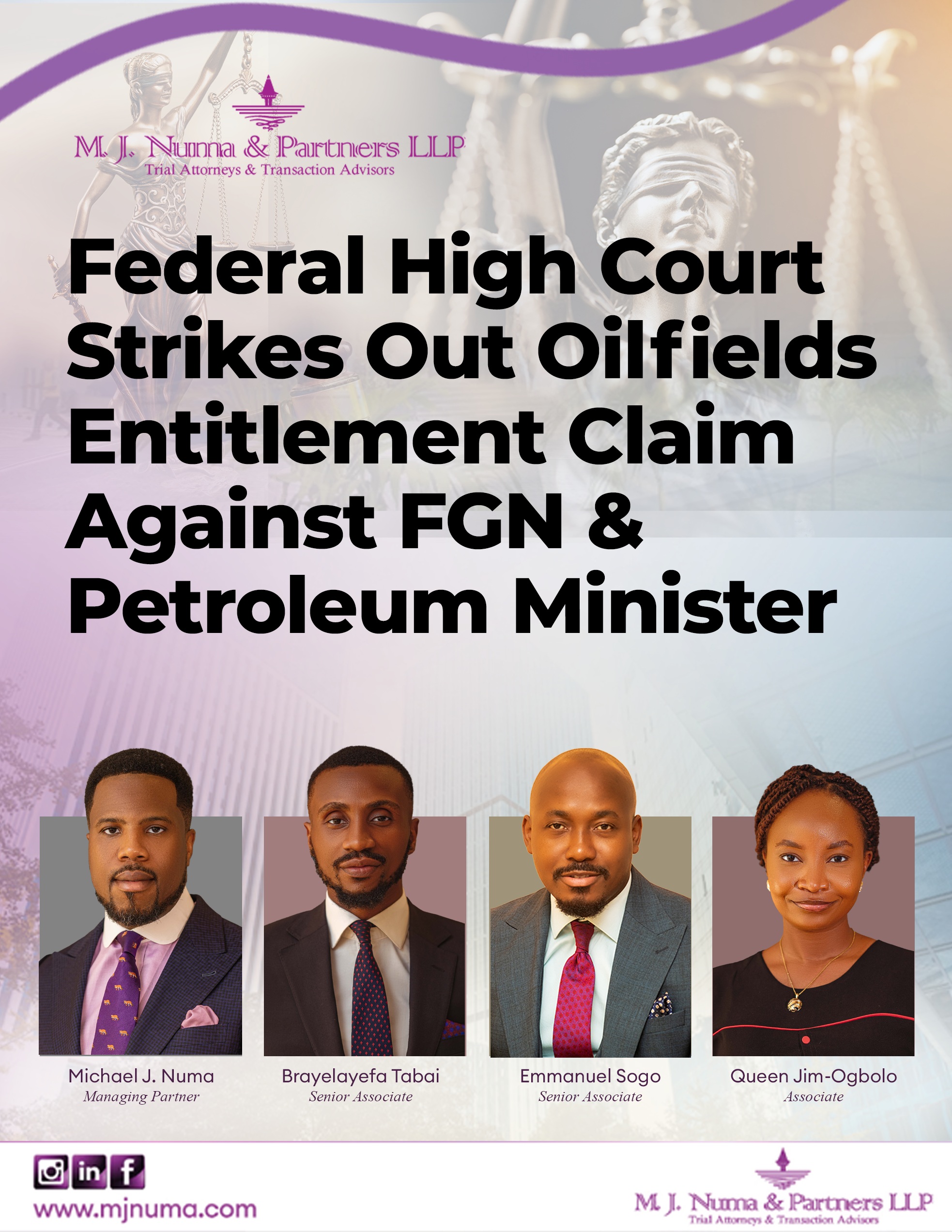
We are pleased to announce a decisive litigation victory secured on behalf of the Honourable Minister of State, Petroleum Resources-Oil before the Federal High Court of Nigeria, Abuja Division. On 20th April 2026, the Court upheld the firm's preliminary objection in its entirety, struck out the suit for want of jurisdiction, and declined to entertain the Plaintiffs' claims at the threshold, without the matter ever proceeding to the merits.
The Challenge
The Plaintiffs commenced the suit by Writ of Summons, seeking far-reaching declaratory, mandatory, and injunctive reliefs compelling the allocation of specific oilfields, Akiapiri (PPL 2A48–OML 25) in Bayelsa State, Diebu Creek East (OML 32) in Bayelsa State, Idiok (PPL 2A1–OML 67) in Akwa Ibom State, and Yorla South (PPL 2A32-OML11) in Rivers State as replacements for an earlier concession withdrawn from them. The reliefs, as framed, invited the Court to override the statutory petroleum licensing framework and confer field-specific exclusivity on the Plaintiffs, thereby directly implicating the regulatory mandate of the Minister and the Nigerian Upstream Petroleum Regulatory Commission. The stakes were significant, not only for the client, but for the integrity of Nigeria's upstream petroleum licensing architecture and the protection of third-party investor interests already engaged in the affected acreage.
Our Strategy
Rather than engaging the claim on its merits and permitting the Plaintiffs to expand their case through trial, the firm identified two fundamental threshold defects that went directly to the court's jurisdiction. On 21st January 2026, the firm filed a Notice of Preliminary Objection on behalf of the 1st Defendant (The Honourable Minister of State, Petroleum Resources-Oil), supported by a comprehensive written address grounded in constitutional principle and statute.
The first ground attacked the very foundation of the Plaintiffs' case. The firm argued, with precision, that the Statement of Claim disclosed no reasonable cause of action because the Plaintiffs did not plead any accrued and enforceable legal right in the four identified oilfields. No allocation, licence, lease, vesting instrument, or other juristic act conferring rights in those fields was pleaded. To the contrary, the Plaintiffs' own pleadings acknowledged that no such right yet existed and sought to have the Court create it through judicial compulsion. The firm submitted that this was not the vindication of an existing civil right within the meaning of Section 6(6)(b) of the Constitution, it was an invitation to judicially procure one. Furthermore, the firm carefully unpacked the 2015 consent judgment relied upon by the Plaintiffs and demonstrated that it contained no field-specific obligation in respect of any of the named oilfields, and that a consent judgment cannot be stretched into an open-ended commercial instrument beyond its express terms.
The second ground was the Plaintiffs' failure to comply with the mandatory pre-action notice requirement under Section 308 of the Petroleum Industry Act, 2021. That provision requires any intending claimant to serve a written notice on the relevant authority before the commencement of suit, and the notice must clearly state the cause of action, the particulars of the claim, the reliefs sought, and an unequivocal intention to sue. The firm demonstrated that the letter relied upon by the Plaintiffs fell well short of these statutory requirements: it lacked the reliefs sought, disclosed no clear intention to institute proceedings, and was bereft of the particulars demanded by the Act. This, the firm submitted, was not a technical deficiency but a jurisdictional one as the Court's authority simply could not be activated without it.
The Ruling
The Federal High Court, in a carefully reasoned ruling, upheld the firm's submissions on both issues.
On the question of reasonable cause of action, the Court held that a cause of action is the combination of facts which give a claimant the right to sue, and that the Plaintiffs had not pleaded any such accrued right. The Court declined to treat the consent judgment as an open-ended commercial understanding, reaffirming that a court cannot import obligations not expressly stated therein and cannot enforce expectations.
On the question of pre-action notice, the Court held that whilst the form of the notice is not in itself decisive, the substance must satisfy the statutory requirements of Section 308 of the PIA, and the letter tendered by the Plaintiffs demonstrably did not. The Court found that the notice lacked the reliefs sought, did not convey an unequivocal intention to sue, and was deficient in the particulars required by statute. The action was accordingly held to be incompetent as presently constituted. Having resolved both issues in favour of the Defendants, the Court held that it lacked jurisdiction to entertain the suit and struck out the matter entirely.
Significance of the Outcome
This outcome is a textbook illustration of strategic threshold litigation at its finest. By identifying and advancing jurisdictional objections with precision and conviction, the firm secured a complete dismissal of a complex petroleum dispute without the client ever being drawn into the costs, delays, and uncertainties of a full trial. The result also reinforces a vital principle of Nigerian petroleum law: compliance with the pre-action notice requirements under the Petroleum Industry Act, 2021 is not a mere technicality, but an indispensable gateway to the court's jurisdiction. Equally, courts will not be instruments for the creation of rights that claimants acknowledge do not yet exist.
This is a victory for principled, disciplined litigation, and a demonstration of the firm's capacity to identify the decisive point and press it to conclusion. Our Dispute Resolution Team was led by our Managing Partner, M.J. Numa, SAN with B.J. Tabai, Esq., Emmanuel C. Sogo, Esq., and Queen M. Jim-Ogbolo, Esq. (Miss).
Click to read the full article
Nigeria’s small business sector, particularly the micro, small, and medium-sized enterprises (MSMEs), plays a critical role in driving the economy. However, in recent years, an increasing number of small businesses have adopted a strict "no refund" policy, leaving customers with little recourse in cases of dissatisfaction.
2024-10-06
We are pleased to announce a decisive litigation victory secured on behalf of the Honourable Minister of State, Petroleum Resources-Oil before the Federal High Court of Nigeria, Abuja Division. On 20th April 2026, the Court upheld the firm's preliminary objection in its entirety, struck out the suit for want of jurisdiction, and declined to entertain the Plaintiffs' claims at the threshold, without the matter ever proceeding to the merits.
2026-04-03