
Home
About Us
Our Team
Newsletters
Practice
Contact
Gallery

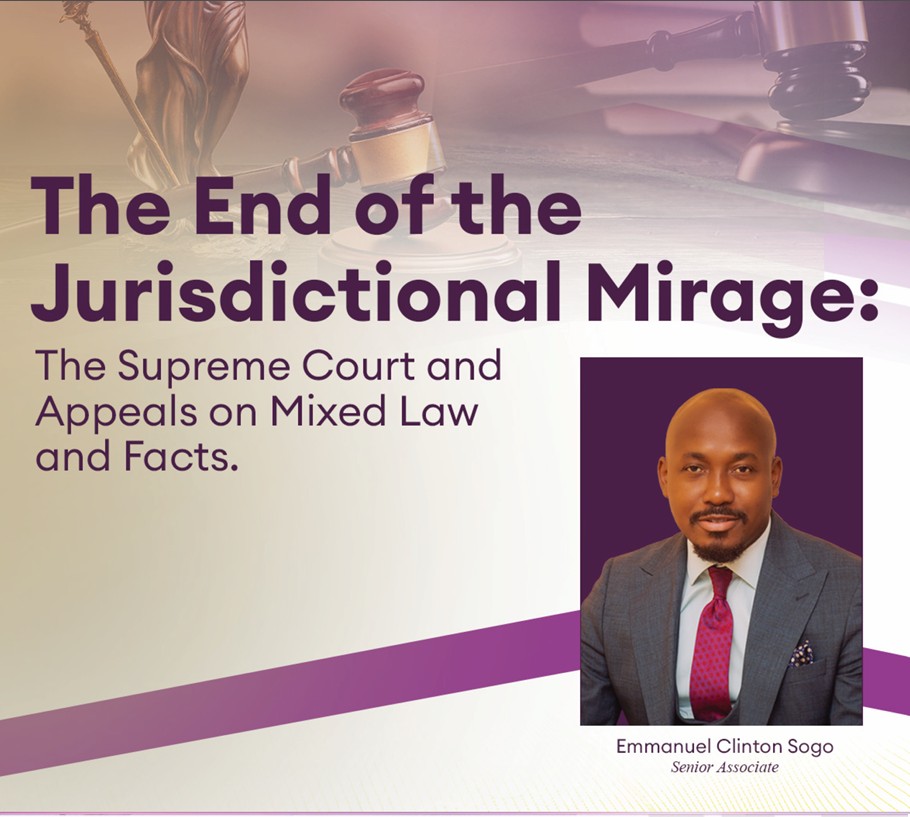
THE END OF THE JURISDICTIONAL MIRAGE: THE SUPREME COURT AND APPEALS ON MIXED LAW AND FACTS
INTRODUCTION
For years, Nigerian lawyers have been caught in a confusing legal maze. Can you appeal to the Supreme Court on grounds of mixed law and facts? The short answer used to be yes, but only with leave. Then came the 2010 constitutional amendment deleting Section 233(3) , and suddenly nobody was sure anymore. Some Judex opined that the door was shut. Others kept it open. Lawyers filed applications not knowing if they were wasting their time and their clients' money.
The December 2025 ruling in FRN v. Gidado & Ors has finally put this debate to rest. Justice Agim, delivering the lead judgment, did not mince words by emphatically stating that appeals on grounds of mixed law and facts still lie to the Supreme Court, and anyone who says otherwise is wrong. This article breaks down how we got here, what the Court said, and what it means for legal practice in Nigeria going forward.
BACKGROUND: HOW DID WE GET HERE?
Let us rewind to understand the confusion. Under the 1999 Constitution as originally enacted, Section 233(1) gave the Supreme Court exclusive jurisdiction to hear appeals from the Court of Appeal. Section 233(2) then listed specific appeals that could be brought as of right, without needing leave from any court.
Section 233(3) (now deleted) was the key provision everyone relied on when bringing appeals bordering on mixed grounds. It provided that appeals not covered by subsection (2) could be brought to the Supreme Court with leave of either the Court of Appeal or the Supreme Court itself. The subsection specifically made a necessary inference that since subsection 2 has listed appeals that lie as of right, then the opposite of same must lie only with the requisite leave sought and obtained, and the very prevalent type of appeal was one anchored on facts alone or mixed law and facts as the case may be.
Then in 2010, the Constitution was amended. The Second Alteration Act deleted subsections (3), (4), (5) and (6) of Section 233. Subsection (3), which had explicitly provided for appeals with leave on grounds of facts or mixed law and facts, was repealed.
For years, courts carried on as before. The Court of Appeal and Supreme Court continued to entertain applications for leave to appeal on mixed grounds. Nobody seemed to think the deletion changed anything fundamental, but then came two judgments that threw everything into question.
The Cases That Complicated the Narrative
Shittu v. Pan Ltd (2018) was the first bombshell. Justice Rhodes-Vivour, in his judgment, remarked that the deletion of Section 233(3) had removed the Supreme Court's jurisdiction to hear appeals on grounds of facts or mixed law and facts. The statement seemed definitive. Appeals on such grounds, he suggested, now ended at the Court of Appeal.
However, that was not actually what the case was about. The real issue was whether the Appellant had properly sought leave before filing those grounds. Unfortunately, they had not, so the grounds were struck out. The comment about jurisdiction being removed was just a comment made in passing. In legal terms, it was obiter dictum, not the actual basis for the decision. This matters because obiter statements do not bind future courts the way ratio decidendi does.
Interestingly, this misunderstanding was clarified in Amadi v. Wopara (2021) wherein Justice Augie stated that Rhodes-Vivour's statement in Shittu’s case was indeed obiter and not binding and went on to hold that the Apex Court still had jurisdiction to hear appeals on mixed grounds, provided leave was sought and obtained.
However, in Eribene v. Ugoh (2025) , which was decided just months before the case under review, Justice Saulawa revived Rhodes-Vivour's position with even more force. He held that the case of Amadi was wrongly decided because Justice Augie had relied on a faulty version of the Constitution that still included the deleted provisions. According to Saulawa, the deletion of Section 233(3) meant exactly what Rhodes-Vivour had said to the extent appeals on mixed grounds terminate at the Penultimate Court.
In ANYANWU v. EMMANUEL & ORS , Saulawa, JSC, reaffirmed this restrictive position, holding that by virtue of the 2010 Second Alteration Act, the Supreme Court no longer has jurisdiction to entertain appeals founded on mixed law and facts. His Lordship maintained that such appeals terminate at the Court of Appeal, thereby reinforcing the earlier view expressed in Shittu v. Pan Ltd, notwithstanding subsequent judicial resistance.
Interestingly, not all the justices in Eriben’s case fully agreed with the stance taken by Justice Saulawa. In a turn of events, Justice Jauro, in his concurring opinion, explicitly disagreed with the lead judgment on the jurisdictional point. He agreed that the grounds in that case were incompetent because leave had not been sought and obtained, but maintained that the Court still had jurisdiction to hear such appeals with leave. His view aligned with Amadi’s case but further muddied the waters.
FRN V. GIDADO: WHAT THE COURT DECIDED
The facts of Gidado itself are not particularly important to the jurisdictional issue. What matters is what the Federal Republic of Nigeria (the Appellant) was trying to do. They wanted to appeal the Court of Appeal's refusal to let them amend their Notice of Appeal to include a Respondent they had accidentally left out. Time had run out to file within the normal 30-day window, so they needed three things: extension of time to seek leave, leave to appeal, and extension of time to appeal which is referred to in practice as the trinity prayers.
The Respondents' lawyer, armed with case laws of Shittu and Eribene respectively, argued that the Supreme Court had no business even hearing the application on the basis that the grounds of the proposed appeal involved mixed questions of law and fact, and the Court no longer had jurisdiction over such appeals.
Justice Agim tackled this head-on. His analysis was methodical and, frankly, devastating to the argument that the 2010 amendment had stripped the Court's jurisdiction. An analysis of his position shall now be done in distinct but concomitant subheads below.
The Constitutional Text Does Not Support Ouster
Section 233(1) provides that the Supreme Court 'shall have jurisdiction, to the exclusion of any other Court of law in Nigeria, to hear and determine appeals from the Court of Appeal.' It does not say 'appeals from the Court of Appeal except those involving facts' or 'appeals from the Court of Appeal on points of law only.' It says 'appeals from the Court of Appeal.'
This position rests on the basic principle of constitutional interpretation where the Constitution uses general language without limiting words, courts must apply that language generally unless other provisions require otherwise. There are no such provisions here. Nothing in the Constitution says the Supreme Court cannot hear appeals involving questions of fact.
Furthermore, notwithstanding the fact that subsection (2) under reference, listed appeals that lie as of right to the Apex Court, it does not limit the Apex Court to only those types of appeals. What Subsection (2) basically did was to identify appeals which can be brought without seeking leave. The natural implication is that other appeals require leave. There is therefore no suggestion that appeals not listed in subsection (2) under reference should not be brought to the Apex Court.
Courts Presume Jurisdiction Unless Clearly Ousted
The judgment cited a well-established principle that every presumption favors a court retaining its jurisdiction unless a statute expressly and unequivocally ousts it as Courts do not infer ouster lightly. If the Constitution wanted to remove the Supreme Court's power to hear appeals on mixed grounds, it would have said so explicitly.
Accordingly, the deletion of subsection (3) cannot be read as such an ouster. All subsection (3) did was restate what already followed from subsections (1) and (2), appeals not covered by subsection (2) require leave. Its deletion does not change the underlying structure. Appeals as of right are commenced by filing a Notice of Appeal. Other appeals are commenced by first seeking leave. This position is made abundantly clear by Section 27(1) of the Supreme Court Act 2004 to the extent that an Appellant gives notice 'or notice of his application for leave to appeal.'
The Inherent Power to Grant Leave
This is the most interesting part of the judgment. Justice Agim held that the power to grant leave to appeal is inherent in the jurisdiction to hear and determine appeals. It does not need to be spelled out in the Constitution or a statute. When a court is given appellate jurisdiction, it automatically has the power to control access to that jurisdiction by granting or refusing leave.
Express provisions about leave, like the old subsection (3), simply emphasize a power that already exists. Their absence does not eliminate the power. The Court compared it to legislative emphasis: sometimes Parliament states something explicitly even though it is already implied, just to make things clearer. Removing that explicit statement does not remove the underlying reality.
In any case, Section 27 of the Supreme Court Act provides a statutory basis for leave applications. It provides that an Appellant 'shall give notice or notice of his application for leave to appeal.' The 'or' makes clear that there are two types of appeals: those filed directly and those requiring leave first. The Supreme Court Act has not been amended to remove this, and it operates alongside the Constitution to regulate appeals.
Obiter Versus Ratio
The Court carefully analyzed the cases of Shittu and Eribene. In both cases, the actual grounds of appeal were struck out because the Appellant had not sought leave. The statements about jurisdiction being removed were not necessary to reach that conclusion. In Shittu, Rhodes-Vivour explicitly said the issue was not raised by the parties. That makes his comment textbook definition of an obiter dictum.
In Eribene, the point was raised, but as Justice Agim noted, even there the justices were not unanimous. Justice Jauro disagreed with the lead judgment's position on jurisdiction. More importantly, the Court acknowledged that after Eribene, the Supreme Court continued to grant leave to appeal on mixed grounds and hear such appeals. This created new precedents that, under the principle of stare decisis, override Eribene.
The law is settled that where Supreme Court decisions conflict, the later one prevails. By continuing to exercise jurisdiction after Eribene, the Court effectively overruled it on this point. For this proposition, we commend the decision of the Apex Court in PRECISION ASSOCIASTES LTD. v. FEDERAL MINISTRY OF FINANCE & ORS (2025) LPELR-81019(SC) wherein it was stated thus:
"This Court is only bound by its own decisions and, where there are two conflicting decisions of the Court, the latter decision should be applied and followed by the Court.
WHAT THIS MEANS FOR PRACTICE
Firstly, appeals on grounds of mixed law and facts are definitively back on the table. You can appeal to the Supreme Court challenging both the Court of Appeal's findings of fact and its application of law to those facts, but you need leave to that.
Secondly, getting that leave is no small feat. The Gidado judgment shows how strictly the Court applies Order 4 Rule 6 of the Supreme Court Rules. Your affidavit must set forth 'good and substantial reasons' for failing to appeal within the prescribed time, and your proposed grounds must prima facie show 'good cause' why the appeal should be heard. Both requirements must be satisfied.
The Court was unforgiving in Gidado. The FRN tried to blame the Court of Appeal for not hearing their leave application quickly enough, but the court did not find merit in it as the Appellant only filed its application only six days before the deadline, having waited 25 days after the Court of Appeal's ruling. There was no explanation for the delay, no evidence of efforts to expedite the hearing, and then another two-month gap before filing in the Supreme Court. The Court called them 'glaringly indifferent' to the statutory time limits.
Thirdly, exceptional circumstances are required. As the Court noted that an enlargement of time would only be granted in exceptional circumstances. Being unaware that your appeal was not filed or waiting for another court to act does not cut it. You need to show diligence on your part.
Moreso, the grounds themselves matter. Even if you have a good excuse for delay, your proposed appeal must show real merit. The Court will look at whether you are raising arguable points that warrant the Supreme Court's attention. Vague complaints or grounds that do not actually engage with the lower court's reasoning will not have the potency of convincing the Apex Court.
Lastly, timing is everything. Do not wait until the last minute to file an application for leave and do not assume extensions will be granted without rigor. The Gidado case is a warning to all that if you create the circumstances for your own failure, the Court will refuse your application without sympathy.
CONCLUSION
The Gidado judgment brings much-needed clarity to Nigerian appellate practice. The confusion sown by Shittu and Eribene has been resolved. Appeals on grounds of mixed law and facts are alive and well. The 2010 constitutional amendment did not put an end to appeals on mixed grounds.
Justice Agim's reasoning is persuasive and, one hopes, final. The Supreme Court's jurisdiction under Section 233(1) is broad and unqualified. The deletion of subsection (3) removed redundant language, not substantive power. The inherent authority to grant leave remains part of the Court's appellate jurisdiction, particularly as the Supreme Court Act provides additional statutory support.
Perhaps most importantly, Gidado demonstrates the Supreme Court's commitment to access to justice. An overly restrictive interpretation of the 2010 amendment would have closed the door on countless appeals raising mixed questions. Many cases involve both factual disputes and legal interpretation. To say the Supreme Court cannot hear such appeals would effectively limit its role to pure questions of law, making it less of a final court of appeal and more of an academic tribunal.
The Apex Court recognized this point by affirming its jurisdiction and preserving its function as the ultimate arbiter of both law and fact in appropriate cases. Leave requirements filter out unmeritorious appeals while ensuring that genuinely important cases can reach the apex court.
Click to read the full article
In February 2026, MTN Group announced its proposed acquisition of the remaining shares in IHS Towers, a transaction that carries profound implications for competition in the sector. The proposed acquisition will face numerous hurdles pertaining to competition regulation in Nigeria, the first and most obvious being the merger control regime.
2026-07-30
The Enron controversy of 2001 and the Nigerian banking crisis of 2009 highlight the fact that modern corporations, which separate ownership from control, create an opportunity for those managing the company to act contrary to the interests of those who fund it. Corporate governance is, in economic terms, the set of mechanisms that constrains those agency costs.
2026-07-30